
The Parts of an Excavator, Explained
The main parts of an excavator include the boom, stick, bucket, cab, counterweight, undercarriage and hydraulic components that power the machine’s movement. Most excavators can be broken down into three major sections: the upper structure, the undercarriage and the front linkage.
The undercarriage supports the machine and allows it to travel, while the upper structure, sometimes called the house, contains the cab, engine, hydraulic equipment and counterweight.
Extending from the upper structure is the front linkage, which consists primarily of the boom, stick and attachment.
Hydraulic cylinders positioned along the boom and stick move these components around their pivot points, allowing the excavator to dig, lift, rotate and operate a variety of attachments.
The Parts of an Excavator Diagram
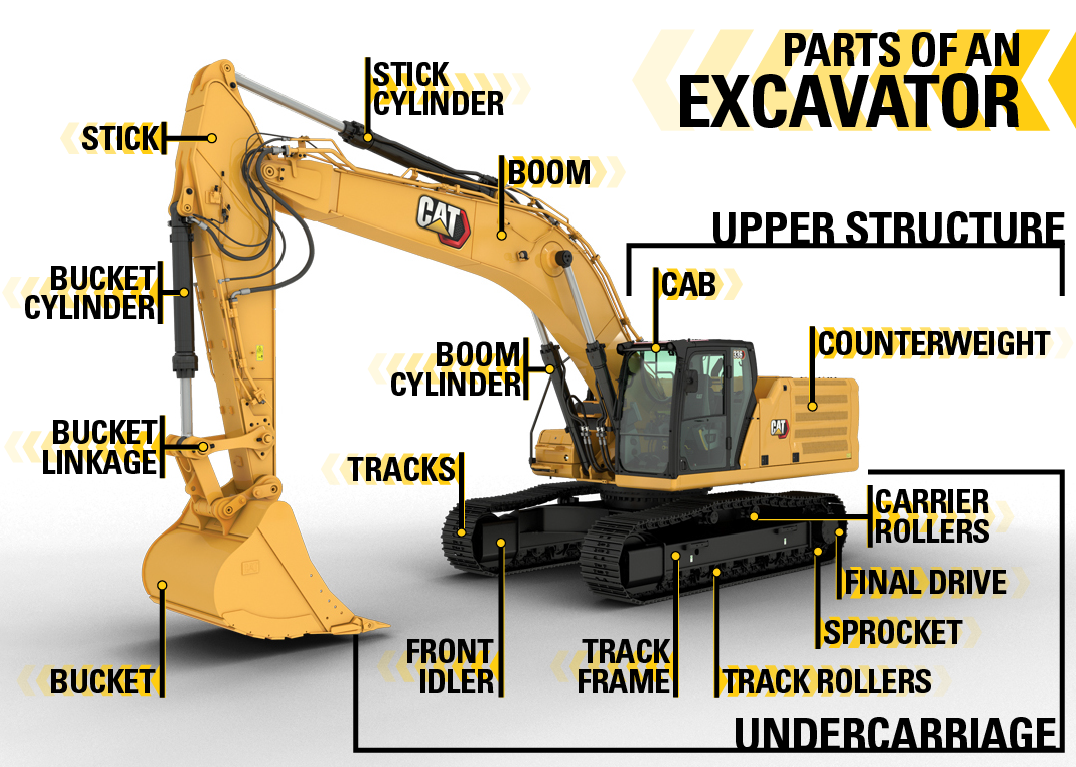
- Cab
- Upper structure/house
- Counterweight
- Boom
- Stick/arm
- Bucket
- Bucket linkage
- Boom cylinder
- Stick cylinder
- Bucket cylinder
- Undercarriage
- Track frame
- Tracks/track shoes
- Sprocket
- Front idler
- Track rollers
- Carrier roller
- Travel motor/final drive
Excavator Parts and Their Functions
| Excavator Part | Where It’s Located | What It Does |
| Upper structure/house | Above the undercarriage | Holds the cab, engine and other major systems and rotates relative to the undercarriage |
| Cab | On the upper structure | Contains the operator station and machine controls |
| Counterweight | Rear of the upper structure | Helps balance the front linkage and its load |
| Boom | Between the upper structure and stick | Raises, lowers and positions the working equipment |
| Stick/arm | Between the boom and attachment | Moves the attachment toward or away from the machine |
| Bucket | End of the stick | Digs, scoops and carries material |
| Bucket linkage | Between the stick, cylinder and bucket | Transfers cylinder movement to the bucket |
| Hydraulic cylinders | Along the boom and stick | Move the boom, stick and bucket |
| Engine | Inside the upper structure | Supplies mechanical power for the machine |
| Hydraulic pump | Inside the upper structure | Supplies hydraulic flow to machine functions |
| Swing system | Between the upper structure and undercarriage | Allows the upper structure to rotate |
| Undercarriage | Bottom of the machine | Supports the excavator and provides mobility |
| Tracks | Around the undercarriage | Provide ground contact and allow tracked machines to travel |
| Sprockets | At the drive end of the tracks | Drive the tracks |
| Idlers | Opposite the sprockets | Guide the tracks and work with the tensioning system |
| Track rollers | Along the bottom of the track frame | Support the machine and guide the track |
| Carrier rollers | Along the upper track run, where equipped | Support and guide the returning track |
| Travel motors/final drives | At the drive end of the track assembly | Supply the torque used to turn the sprockets |
Upper Structure
The upper structure, commonly called the house, is the portion of the excavator located above the undercarriage. The entire upper structure can rotate relative to the lower portion of the machine.
This distinction is important because the house and cab are not the same thing. The cab is one component of the upper structure.
The upper structure also contains many of the systems responsible for powering and controlling the excavator.
Cab and Operator Controls
The cab is the operator’s workstation. Depending on the excavator, it may contain joysticks, travel controls, pedals, switches, displays and other controls used to operate and monitor the machine.
Cab configurations vary. For example, some compact excavators may be available with either an enclosed cab or an open canopy.
Engine
On a conventional diesel hydraulic excavator, the engine provides the mechanical power needed to operate the machine.
One of its most important jobs is driving the hydraulic pump system. The engine compartment also contains supporting parts related to cooling, air intake, electrical power and other machine systems.
Counterweight
The counterweight is the heavy mass located at the rear of the upper structure.
Its purpose is to help balance the weight and forces created by the boom, stick, attachment and material being handled in front of the machine.
The counterweight is only one factor in machine stability. Load position, machine configuration, ground conditions and other factors also affect stability and lifting capacity.
Swing Motor, Swing Drive and Swing Bearing
The swing system allows the upper structure to rotate while the undercarriage remains stationary.
Several parts work together to make this possible.
The hydraulic swing motor provides rotational power. The swing drive transfers that power through gearing, while the large swing bearing, sometimes called a slewing ring, supports the upper structure and allows it to rotate relative to the undercarriage.
This is what allows an excavator to dig in one location, rotate and place the material somewhere else without repositioning its tracks.
Undercarriage
The undercarriage is the lower portion of the machine. On a tracked excavator, it supports the machine’s weight and contains the parts needed for travel. Because undercarriage components are constantly exposed to dirt, rock, mud and other abrasive materials, they are also important areas to inspect for wear.
Track Frame
The track frame provides the structural foundation for each track assembly. Parts such as rollers, idlers and other undercarriage parts mount to or operate around this structure.
Track Chains and Track Shoes
On a conventional steel-track excavator, the track chain is made from interconnected links, pins and bushings.
Track shoes attach to the track links and provide the surface that contacts the ground.
Track shoe designs and widths vary depending on the machine and application. Wider shoes can distribute machine weight over a larger surface area, while other configurations may be designed for different terrain or operating conditions.
Not every excavator uses exposed steel track shoes. Some mini excavators use rubber tracks or other track configurations.
Sprockets
The sprocket is the toothed drive component that engages with the track assembly.
When the travel system turns the sprocket, the sprocket drives the track around the undercarriage and moves the machine.
Travel Motors and Final Drives
Hydraulic travel motors provide the rotational power needed for tracked movement. The final drive uses reduction gearing to convert that rotation into the torque needed to turn the sprocket and move the machine.
Although the travel motor, final drive and sprocket all contribute to movement, they are separate parts with different jobs.
Idlers
The idler is the large non-driving wheel located at the opposite end of the track assembly from the sprocket.
It guides the track around the end of the undercarriage and works with the track-adjusting system to maintain proper track tension.
Track Rollers
Track rollers, sometimes called bottom rollers, are positioned along the lower portion of the track frame.
They help support the machine’s weight and guide the track as the excavator travels.
Carrier Rollers
Carrier rollers, where equipped, are positioned along the upper portion of the track frame.
Rather than supporting the machine’s weight in the same way as bottom rollers, carrier rollers support and guide the upper return portion of the track.
Tracked vs. Wheeled Excavators
Not every excavator has a crawler-style undercarriage.
Wheeled excavators use tires, axles, steering and braking components instead of tracks. They still have an upper structure and front linkage, but their lower assembly is fundamentally different from a tracked excavator.
Mini excavators can also differ from larger crawler excavators. Depending on the model, they may include features such as a blade, expandable undercarriage or boom-swing system.
Front Linkage (Boom, Stick and Bucket)
The front portion of an excavator is often called the front linkage or working equipment.
Its three most recognizable components are the boom, stick and bucket. Hydraulic cylinders move these structural parts around pivot points to position the bucket or another attachment.
Boom
The boom is the large structural member connected directly to the upper structure.
It extends outward and upward from the machine and supports the stick and attachment. Hydraulic boom cylinders raise and lower it.
The boom is sometimes confused with the stick, but they are separate parts.
Stick, Arm or Dipper
The stick connects the boom to the bucket or other work tool.
You may also hear this part called the arm or dipper arm. These terms commonly refer to the same general component.
Movement of the stick changes the distance between the attachment and the machine. During digging, for example, the stick can be pulled inward to draw the bucket toward the excavator.
Bucket
The bucket is the attachment most commonly associated with an excavator. It is designed to penetrate, scoop, hold and move material.
Different bucket designs are available for different jobs. A digging bucket may use teeth to penetrate material, while grading or clean-up buckets may have a wider profile and different cutting edge.
Buckets can also include replaceable wear components such as:
- Bucket teeth
- Cutting edges
- Side cutters
- Adapters
- Other ground engaging tools
These parts contact the material being excavated and can help protect the underlying bucket structure from wear.
Bucket Linkage
The bucket linkage is the group of links and pivot points near the connection between the stick and bucket.
It transfers movement from the bucket cylinder to the bucket, allowing the bucket to curl inward or open outward.
Because several parts meet in a relatively small area, this section of the machine contains multiple pins, bushings and pivot points.
Pins and Bushings
Pins connect moving sections of the excavator at pivot points. Bushings provide replaceable bearing surfaces inside those joints. Together, pins and bushings allow parts such as the boom, stick, bucket and linkage to pivot while carrying substantial loads. Wear in these areas can lead to increased movement or looseness at a joint.
Hydraulic Cylinders
Hydraulic cylinders provide the force that moves the excavator’s front linkage.
Most conventional configurations use separate cylinder arrangements to control the:
- Boom
- Stick
- Bucket
Inside a hydraulic cylinder, pressurized hydraulic fluid moves a piston and rod in a straight line. Because the cylinder is attached to parts at pivot points, that straight-line movement causes the boom, stick or bucket to rotate around its joint.
How the Parts of an Excavator Work Together
Knowing the individual parts of an excavator is useful, but the machine makes more sense when you see how all these components work together.
Let’s walk through a basic digging cycle, for example.
1. Positioning the Bucket
The engine supplies mechanical power to the hydraulic system. The pump supplies hydraulic flow, and the control system directs that flow to the appropriate cylinders. The boom and stick cylinders move the front linkage until the bucket is positioned for the cut.
2. Digging
The operator coordinates the stick and bucket movements. The stick can draw the bucket toward the machine while the bucket cylinder acts through the bucket linkage to curl the bucket through the material.
3. Raising the Load
The boom cylinders raise the front linkage and loaded bucket. At the same time, the undercarriage supports the machine while the counterweight helps balance the forces created by the load in front of the excavator.
4. Swinging
Hydraulic power is sent to the swing motor. The swing system rotates the upper structure while the undercarriage can remain stationary, allowing the operator to reposition the bucket over the desired unloading location.
5. Dumping
The bucket cylinder moves the bucket linkage in the opposite direction, opening the bucket and releasing the material. The process can then be repeated.
This example shows why it is useful to think of excavator anatomy as a collection of connected systems rather than a simple list of parts. The engine, hydraulic system, structural components, undercarriage and work tool all contribute to the machine’s operation.
How the Excavator Hydraulic System Works
The hydraulic system is what turns engine power into most of the movement you see when an excavator operates. The process works like this:
Engine power → hydraulic pump → controlled hydraulic flow → cylinder or motor movement
The actual system is more complex, but understanding these four steps makes it easier to see how the different parts of an excavator work together.
Hydraulic Pump
The engine drives the hydraulic pump, which creates hydraulic fluid flow for the machine’s hydraulic circuits.
That flow can then be directed to the part responsible for the movement the operator wants to perform.
Control Valves
Hydraulic control valves route and meter hydraulic fluid through different circuits. When an operator commands a function, such as raising the boom, the hydraulic system directs flow toward the appropriate actuator.
Hydraulic Cylinders
Hydraulic cylinders convert hydraulic energy into linear movement. On the front linkage, cylinders move the boom, stick and bucket.
Hydraulic Motors
Hydraulic motors convert hydraulic energy into rotational movement.
Excavators use hydraulic motors for functions such as:
- Swinging the upper structure
- Driving the tracks
This difference helps explain why an excavator uses cylinders for some movements and motors for others.
Hydraulic Hoses and Lines
Hydraulic hoses and rigid lines carry hydraulic fluid between pumps, valves, cylinders, motors and other parts. Because these lines operate as part of a pressurized system, leaks, abrasion and other damage require proper inspection and service procedures.
Hydraulic Reservoir and Filters
The hydraulic reservoir stores hydraulic fluid used by the system. Filters help control contamination as the fluid circulates through the machine. Cooling components also help manage hydraulic system temperature. These parts may not be as visible as the boom or bucket, but they are essential to hydraulic operation.
Central Swivel
One challenge with excavator design is that the upper structure rotates while hydraulic power still needs to reach components in the lower portion of the machine. The central swivel, also called a rotary hydraulic joint, allows hydraulic fluid to pass between the rotating upper structure and the undercarriage.
This allows hydraulic power to reach the travel system without ordinary hoses becoming twisted around the machine’s center of rotation.
The central swivel should not be confused with the swing motor. The swivel transfers hydraulic fluid across the rotating connection, while the swing system actually turns the upper structure.
Excavator Attachments and Work Tools
The bucket may be the most recognizable excavator attachment, but excavators can operate many different work tools.
Digging Buckets
Digging buckets are designed for excavating and loading materials such as soil. Bucket width, capacity, teeth and construction vary based on the intended application.
Grading and Clean-Up Buckets
Grading or clean-up buckets typically have a wider profile than standard digging buckets and are used for applications such as shaping surfaces, grading and ditch clean-up.
Hydraulic Hammers
A hydraulic hammer uses hydraulic power from the excavator to repeatedly strike material. Hammers are commonly used for breaking rock, concrete and similar materials.
Augers
An auger turns a helical drilling tool to create holes in suitable ground. Common applications can include holes for posts, footings and other site work.
Grapples
Grapples are designed to grab, hold and move material. Different grapple designs are available depending on the material being handled.
Thumbs
A thumb works against the excavator bucket to help grip irregular materials that would otherwise be difficult to hold securely in the bucket alone.
Compactors
Excavators can use compaction attachments for suitable backfill and site work. Depending on the attachment, this may include compaction wheels or hydraulically powered vibratory plates.
Rippers
A ripper uses a strong pointed tooth or shank to break into hard or difficult material before it is excavated.
Quick Couplers
A quick coupler provides a connection between the excavator and compatible work tools and can simplify attachment changes.
Physical fit alone does not mean an attachment is compatible with a particular machine. Attachment selection can depend on machine size, weight, mounting system, hydraulic flow, pressure and other requirements.
Parts That Wear and Need Regular Attention
Excavators operate in dirt, rock, mud and other demanding conditions. Parts that regularly contact the ground, move around pivot points or carry hydraulic fluid can experience wear over time.
Bucket Teeth and Cutting Edges
Bucket teeth, cutting edges and other ground engaging tools make direct contact with the material being excavated.
Regular inspection can help identify worn, damaged or missing components before additional wear reaches the underlying bucket structure.
Pins and Bushings
Pins and bushings allow the boom, stick, bucket and linkage to move around their pivot points.
These joints should be inspected and lubricated according to the machine manufacturer’s recommendations.
Hydraulic Hoses and Cylinders
Hydraulic hoses and connections should be inspected for visible damage, abrasion and leakage.
Cylinder rods should also be checked for visible damage that could affect seals or cylinder operation.
Hydraulic systems can retain pressure even when a machine is not operating. Never use your hand to search for a hydraulic leak, and follow the machine’s specified safety and pressure-relief procedures before performing service.
Tracks and Undercarriage Components
The undercarriage can represent a significant wear area on a tracked excavator. Parts to monitor include:
- Track shoes or rubber tracks
- Track links
- Pins and bushings
- Rollers
- Carrier rollers
- Idlers
- Sprockets
- Track tension
Wear patterns can vary based on ground conditions, machine operation and maintenance practices. Fabick Cat offers undercarriage inspections and service for Cat equipment when a more detailed wear assessment is needed.
Filters and Fluids
Engine oil, hydraulic fluid, coolant and other fluids perform different jobs within the machine.
Filters help protect machine systems from contaminants. Fluid levels, filter servicing and change intervals should follow the recommendations for the specific excavator rather than a universal schedule.
How to Identify the Right Part for Repair
Knowing the name of a component can make finding a replacement much easier, but the name alone is not always enough. For example, identifying something as a track roller tells you what type of part you need. It does not necessarily identify the correct track roller for your particular excavator.
When identifying a replacement part, useful information can include:
- Machine model
- Machine serial number
- Component or assembly
- Existing part number, when available
- Photos showing the component and where it is installed
For Cat equipment, machine-specific parts information is available through Cat SIS, which provides access to parts and service information for Cat equipment.
If you know which component you need, Fabick Cat also offers new, used and remanufactured parts.
If the cause of a machine issue is unclear, our service experts can help with equipment inspection, maintenance and repair needs.
Other Frequently Asked Questions About Excavator Parts
What are the main parts of an excavator?
The main parts of an excavator can be grouped into three sections: the upper structure, undercarriage and front linkage. Major parts include the cab, engine, counterweight, swing system, tracks, boom, stick, bucket and hydraulic system.
What is the arm of an excavator called?
The outer structural member connecting the boom to the bucket or attachment is commonly called the stick, arm or dipper arm. The stick and boom are separate parts.
What is the difference between the boom and stick on an excavator?
The boom connects to the excavator’s upper structure. The stick connects the boom to the bucket or other attachment. Together, their movements position the work tool.
What is the bottom of an excavator called?
The bottom supporting assembly is called the undercarriage. On a tracked excavator, the undercarriage includes the track frames, tracks, sprockets, idlers, rollers and travel components.
What is the house of an excavator?
The house is another name for the excavator’s upper structure. It includes the cab, engine, counterweight and other major components and rotates relative to the undercarriage.
What makes an excavator rotate?
A hydraulic swing motor supplies rotational power to the swing drive. A large swing bearing supports the upper structure while allowing it to rotate relative to the undercarriage.
What are excavator tracks called?
The complete lower tracked assembly is part of the undercarriage. On a steel-track machine, the track itself consists of interconnected track links with track shoes attached to them. Sprockets, idlers and rollers guide and drive the track but are separate parts.
How does an excavator hydraulic system work?
The engine drives a hydraulic pump, which supplies hydraulic fluid flow. Control valves direct that flow to hydraulic cylinders and motors. Cylinders create linear movement for functions such as the boom, stick and bucket, while hydraulic motors provide rotational movement for functions such as swing and travel.
What part of an excavator does the digging?
The bucket typically makes direct contact with the material during digging. However, the boom, stick, bucket linkage and hydraulic cylinders all work together to position and move the bucket through the material.
What attachments can be used on an excavator?
Depending on the machine and its configuration, excavators can use digging buckets, grading buckets, hydraulic hammers, augers, grapples, thumbs, compactors, rippers and other work tools. Attachment compatibility should always be verified for the specific excavator.
Understanding Your Excavator from the Ground Up
An excavator becomes much easier to understand once you break it into its major systems.
The undercarriage supports and moves the machine. The upper structure contains the operator station and many of the systems that power the excavator. The boom, stick and attachment perform the work, while the hydraulic system supplies the force needed to move them.
From there, individual parts such as sprockets, idlers, cylinders, pins, bushings and bucket teeth become easier to identify because you can connect each part to the larger assembly it belongs to.
If you are trying to identify a specific part for replacement rather than learning excavator anatomy, start with the machine model and serial number. From there, machine-specific parts information can help narrow the general component name down to the correct part for your equipment.